

Yes, we are talking about “land for Hornbills by 2047”. This isn't just a slogan. It's the opening move in what could become one of India's most community-rooted conservation efforts, timed deliberately to land in the same year the country marks a century of independence
There's a sound that old-timers in Arunachal Pradesh's forest villages will tell you not to forget. It's the deep, rhythmic whoosh of a hornbill's wings cutting through the canopy before dawn.
That sound has grown rarer over the decades, as forests outside protected reserves have thinned and fragmented. Now, the state wants to make sure it never disappears altogether.
In July 2026, Arunachal Pradesh set itself an ambitious target: to become a "Land for Hornbills by 2047." The pledge came out of a three-day workshop at Arunachal Pradesh University in Pasighat.
More than 55 people took part — forest officials, Indigenous community leaders, scientists, and conservationists. Together, they sketched out what a hornbill-friendly future for the state could actually look like.
Why Do Hornbills Matter So Much to Arunachal Pradesh?
Arunachal Pradesh's vision of becoming the "Land for Hornbills by 2047" is rooted in its extraordinary biodiversity. The state is home to five of India's nine hornbill species: the Great Hornbill, Wreathed Hornbill, Rufous-necked Hornbill, Austen's Brown Hornbill, and Oriental Pied Hornbill. Three of these are globally threatened, while all five enjoy the highest level of legal protection under India's Wildlife (Protection) Act.
What Does the Hornbill Mean Culturally?
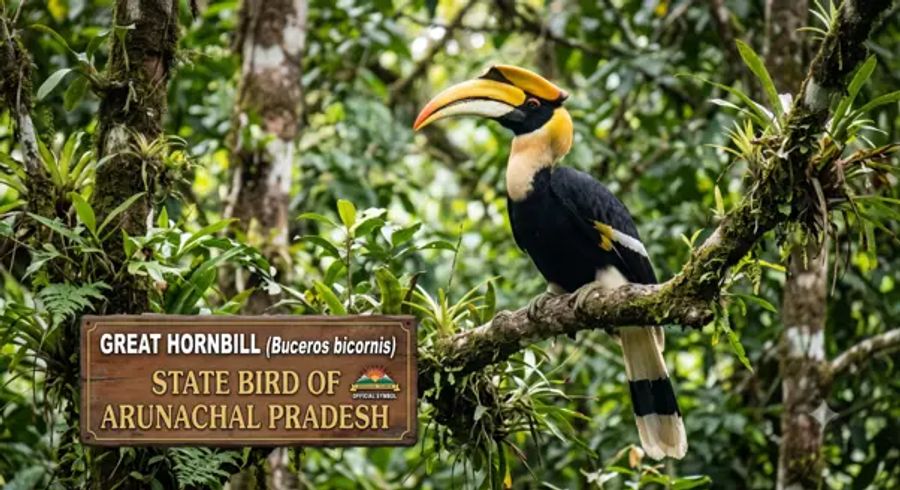
The Great Hornbill isn't just another species on the list—it's the state bird of Arunachal Pradesh and the inspiration behind the state's "Land for Hornbills by 2047" vision. Its casque and feathers hold deep cultural significance for many Indigenous communities, who have traditionally used them in ceremonial headgear. Losing hornbills wouldn't just be an ecological loss; it would also mean losing an important part of Arunachal Pradesh's cultural heritage.
What Role Do Hornbills Play in the Forest Itself?
There's also a practical, almost economic case for protecting them. Hornbills are often called "farmers of the forest" because of how they disperse seeds across huge distances as they forage on fruit.
A healthy hornbill population is, in many ways, a proxy for a healthy forest.
Why Is This Vision Coming Together Right Now?
Despite nearly 80 percent forest cover across the state, hornbill populations outside formally protected areas are under real pressure. Habitat degradation, forest fragmentation, and hunting are all chipping away at their numbers.
That's exactly the problem organisers flagged at the Pasighat workshop.
Aren't Protected Reserves Already Doing That Job?
Protected reserves like Pakke Tiger Reserve remain strongholds for hornbills. But reserves alone aren't enough.
The birds need connected, healthy forest corridors well beyond reserve boundaries to survive long term. That's a gap no single reserve can close on its own.
Who Was in the Room at Pasighat?
The three-day workshop that laid the foundation for Arunachal Pradesh's "Land for Hornbills by 2047" vision was held from July 16 to 18. It was organised by the Nature Conservation Foundation (NCF) in collaboration with Arunachal Pradesh University's Department of Economics, the Department of Environment, Forests and Climate Change, and the Zoo Outreach Organization.
The workshop brought together key stakeholders, including the Arunachal Pradesh Forest Department, the State Biodiversity Board, Rajiv Gandhi University, the Indian Institute of Science (IISc), the Wildlife Trust of India (WTI), and ATREE.
Representatives from WWF-supported community conservation groups, the Nagaland Forest Department, the Nagaland Community-Conserved Areas Forum, and Assam-based Aaranyak also participated, making the "Land for Hornbills by 2047" initiative a truly collaborative effort across Northeast India.
Why Does That Mix of Stakeholders Matter?
This isn't shaping up to be a top-down forest department project handed down to villages. It's meant to be built with the communities who share their land with hornbills every day.
The approach blends traditional ecological knowledge with the kind of long-term scientific monitoring that groups like NCF have been running in Arunachal for years.
What Did the Workshop Actually Produce?
Out of the workshop came a shared vision and an initial action framework. A drafting committee is now refining that into a formal document.
The first draft is expected by September 2026. The complete State-wide Hornbill Conservation Action Plan is targeted for early 2027.
Dr. Aparajita Datta, Executive Director and Senior Scientist at NCF and Co-Chair of the IUCN SSC Hornbill Specialist Group, has been closely associated with the push. The workshop was supported by the Whitley Fund for Nature and two IUCN Species Survival Commission groups — the Hornbill Specialist Group and the Conservation Planning Specialist Group.
What Does the Plan Actually Focus On?
What stands out about this initiative is its scope — it isn't confined to a single reserve or district. The strategy on the table rests on three pillars.
First, supporting Indigenous communities as the primary stewards of forest land. Second, improving habitat connectivity so hornbill populations aren't cut off in isolated pockets. Third, building long-term partnerships that stretch across state lines into neighbouring landscapes in Nagaland and beyond.
Why Does Crossing State Lines Matter?
Hornbills don't recognise administrative borders, and neither does forest degradation. A conservation plan that stops at a district line, or even a state line, only goes so far.
That's why the transboundary thinking here matters more than it might seem at first glance.
Is Livelihood Part of the Plan Too?
Yes. Organisers have been clear that this isn't conservation for its own sake.
It's meant to work alongside sustainable livelihoods linked to biodiversity. Protecting hornbill habitat and supporting local economies aren't treated as competing goals.
Why Set the Target for 2047 Specifically?
Why 2047? The target year aligns with India's 100th year of independence. It also reflects the broader "Viksit Bharat 2047" vision, which encourages states to set long-term development goals. By linking the "Land for Hornbills by 2047" initiative to this national milestone, Arunachal Pradesh is making a clear statement: biodiversity conservation is not separate from development—it is an essential part of the state's future.
Why Give the Plan Two Decades?
Forest corridors don't regenerate overnight. Shifting hunting practices or land-use patterns in remote hill communities takes sustained engagement, not a five-year project cycle.
A 2047 horizon gives the plan room to actually work.
What Happens Next for the Hornbill Conservation Action Plan?
For now, the "Land for Hornbills by 2047" vision is still in its early, formative stage. It's a shared framework, not yet a finished blueprint.
The real test comes over the next several months. The drafting committee has to turn broad agreement into specific, actionable commitments — which corridors get prioritised, how communities get supported and compensated, and how progress gets tracked over the next 21 years.
What's at Stake if It Succeeds?
If the "Land for Hornbills by 2047" vision succeeds, Arunachal Pradesh won't just be protecting five iconic hornbill species. It will set a powerful example of how a biodiversity-rich state can combine Indigenous knowledge, community participation, and science-driven conservation to safeguard its natural heritage. The initiative could become a model for the Eastern Himalayas—and perhaps for conservation efforts across India.