
If you're not a resident of Arunachal Pradesh, you cannot legally enter the state without an Inner Line Permit (ILP). This applies to every Indian citizen — no exceptions for a confirmed hotel booking, a flight ticket, or a tour package. The checkpost staff at the state border will turn you back without one.
The good news is that the process is now fully online, free of the old office-visit hassle, and takes about 15 minutes if your documents are ready. This guide walks through the current process step by step, using the actual fee structure and rules on the government's own portal — several older guides online still quote a flat ₹100 fee and a 30-day validity, both of which have changed.
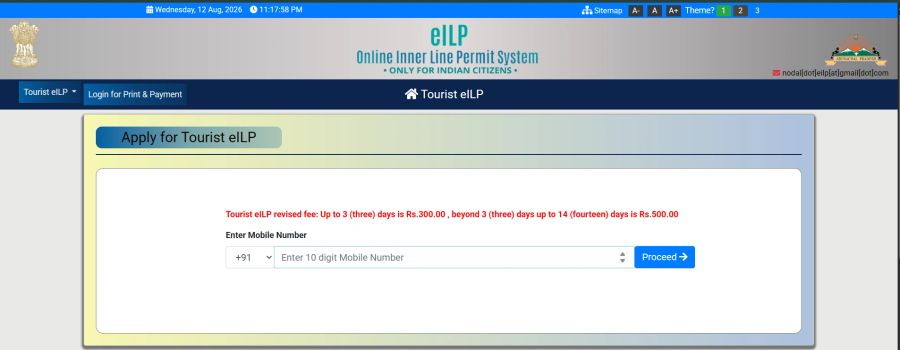
Go to the official portal. Visit the official Tourist eILP application page on the Government of Arunachal Pradesh website and select the option to apply for a Tourist eILP.
Quick Facts on ILP For Arunachal Pradesh
What the ILP For Arunachal Pradesh Actually Is
The Inner Line Permit traces back to the Bengal Eastern Frontier Regulation of 1873, a British-era rule designed to control movement into tribal areas along the northeastern frontier. Independent India retained the system for Arunachal Pradesh, Nagaland, Mizoram, and Manipur, and it's administered today under the Foreigners (Protected Areas) Order, 1958.
Arunachal Pradesh is home to 26 major tribal communities and over 100 sub-tribes, and the state government uses the ILP to regulate and track who enters the state. It isn't a security clearance and it isn't a visa — it's closer to a domestic travel authorization tied to specific dates, districts, and an entry gate.
Areas near the China and Myanmar borders (Mechuka, Vijaynagar, Anini, parts of Upper Siang, and a few others) carry additional restrictions and may require further clearance beyond a standard tourist ILP — check with the District Commissioner's office for your specific route if it goes that far off the main circuit.
Who Needs One — and Who's Exempt
- Every Indian citizen who is not a bona fide resident of Arunachal Pradesh needs an ILP, regardless of how you arrive — by road, by air into Hollongi (Itanagar) or Tawang, or otherwise.
- Children need a permit too. A parent or guardian applies on their behalf; several sources note children under 14 travelling with an adult may be covered without a separate application in some cases, but the safer, verified approach is to include every traveller's photo and ID on the application rather than assume an exemption.
Documents You Need to Get an ILP For Arunachal Pradesh
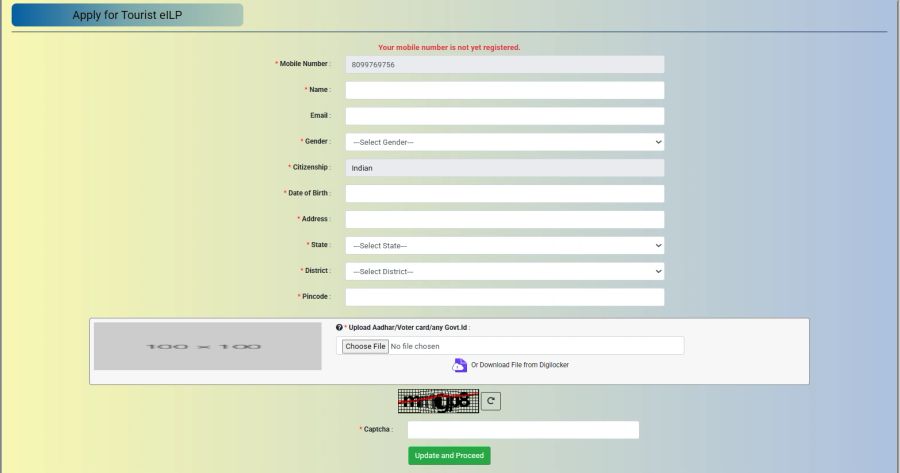
Your name on the form has to match your ID exactly — no abbreviations, no dropped middle names. A mismatch is one of the most common reasons applications get sent back for correction.
Need an ILP for Arunachal Pradesh?
Get assistance with your Arunachal Pradesh ILP application and travel documentation before your trip.
How to Apply an ILP for Arunachal Pradesh: Step by Step
- Start a new application. Click through to "Apply for Tourist eILP," read the declaration, and proceed.
- Verify your mobile number. You'll receive an OTP by SMS to confirm it.
- Fill in personal details. Full name (exactly as on your ID), father's name, date of birth, permanent address, and ID number.
- Upload your photo and ID scan. Keep files within the size limits stated on the form, or the upload will fail silently in some browsers.
- Enter your travel plan. List every district you intend to visit and select the correct entry/exit gate for your actual route — Bhalukpong for the classic Tawang circuit, Kimin for Ziro, Pasighat for the eastern districts. Choosing the wrong gate can mean your permit isn't valid at the checkpost you actually arrive at.
- Pay the fee. ₹300 for up to 3 days, ₹500 for 4–14 days. Pay via UPI, card, or net banking, and hold on to the transaction reference.
- Wait for approval, then download and print. You'll get a status update by SMS/email. Once approved, download the PDF and print at least two copies.
How to Check Your ILP Application Status
Log back into the portal to track your application — it will show as Pending, Approved, or Rejected (with a reason, if rejected). If it stays pending well beyond a normal working day, a call to the support contact listed on the portal usually helps more than waiting.
This is a revised structure — older articles and even some still-live blog posts quote a flat ₹100, which is no longer accurate. If you go through a private tour operator instead of applying yourself, expect the government fee plus a separate service charge, which varies by operator.
Validity — and What to Do If You Need Longer
A standard tourist eILP covers a maximum of 14 days. If your trip runs longer than that, the tourist eILP isn't the right instrument — you'd need a provisional/regular ILP through the appropriate channel, which involves a different process and paperwork. For most tourist circuits (Tawang, Ziro, the East/West Siang loop), 14 days is comfortably enough; a dedicated Tawang trip typically runs 7–9 days, and a Ziro–Daporijo–Along route runs 8–10.
Your permit is tied to the specific dates and districts you entered — not a rolling window. If your plans shift (an extra day, an added district), the safer move is a fresh or extended application rather than assuming the checkpost will wave you through.
ILP vs. Protected Area Permit (PAP)
These two get confused constantly, so here's the actual split:
If you're doing the standard tourist circuit as an Indian citizen, the ILP alone covers you. If you're a foreign national, or an Indian planning to reach a border-adjacent restricted area, you'll need to look into PAP requirements specifically for that district well before your trip — don't leave it to be sorted at the gate.
Common Reasons Applications Get Stuck
- Photo doesn't meet spec. Selfies, sunglasses, oversized files — get a proper photo taken; it costs very little at any studio.
- Name mismatch with ID. Type it exactly as printed on your Aadhaar, Voter ID, or Passport.
- Using a PAN card as ID. It's no longer accepted, since it doesn't show an address.
- Wrong entry/exit gate selected. It needs to match your actual physical route, not just be "close enough."
- Districts that don't match a realistic itinerary. Listing far more districts than your dates support can prompt questions from the reviewing officer.
- Payment not confirmed. Always wait for and save the payment confirmation before assuming your application is in the queue.
Practical Tips for Getting an ILP for Arunachal Pradesh
- Carry at least two or three printed copies — the border checkpost and several district-boundary checkposts will each want to see one.
- Keep a digital copy on your phone and email it to yourself as a backup in case you lose the printouts or signal drops.
- Double-check your entry date against your actual arrival — showing up a day early or late relative to what's on the permit can cause problems at the gate.
- Hotels and homestays in Arunachal are legally required to check your ILP at check-in, so keep it somewhere accessible, not buried in your luggage.
- Border checkposts generally close by early evening — plan your travel to cross before dark rather than risk being stuck at the border overnight.
- Apply several days ahead of travel, not the night before. Processing is usually fast, but peak season (broadly October–March, when Tawang traffic peaks) can slow things down.
Conclusion
The ILP for Arunachal Pradesh isn't the obstacle it used to be. What was once a multi-day trip to a government office is now a form you can fill out from your phone in about 15 minutes, provided your photo, ID, and itinerary are ready before you start. The parts that actually cause delays are avoidable: a mismatched name, the wrong entry gate, an oversized photo file, or applying the night before you travel.
Apply a few days ahead, double-check your details against your ID exactly as printed, and match your listed districts and gate to your real route. Do that, and the permit becomes a formality rather than a bottleneck — leaving you to focus on the actual trip, not the paperwork.